Norton Threemonger
The Tiger RisingNorton Threemonger is a schoolmate who bullies Rob Horton alongside his brother, Billy Threemonger. On the bus, Norton turns Rob’s association with the Kentucky Star Motel into a taunt, then uses physical intimidation; later, he and Billy keep harassing Rob outside the motel. His role is defined by repeated cruelty, but the scenes also expose the isolation that allows it to continue: the bus driver pretends not to see, and Rob calculates that resisting may only prolong the attack.
Identity and Introduction
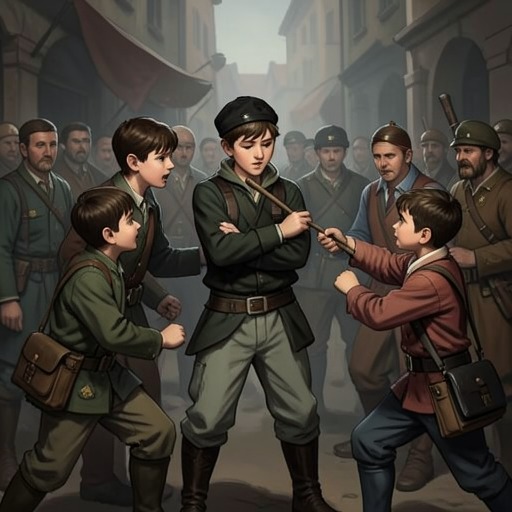
Norton first confronts Rob as he boards the school bus. Standing in the center of the aisle and blocking Rob’s way, he mocks the Kentucky Star sign and asks how it feels to be a star. The joke makes Rob’s motel home into a public label, turning an ordinary ride to school into an encounter in which Norton controls the passage and the conversation.
Norton draws Billy into the mockery, calling to his brother and presenting Rob as someone who does not understand what it means to be a star. The exchange establishes their shared role in the bullying: Norton initiates the taunt, while Billy echoes and extends it. Their attention is not casual teasing; the boys crowd Rob and make his status as an outsider the subject of a coordinated performance.
Bullying on the Bus
After following Rob to his seat, Billy sits close beside him and insults him, while Norton returns to the confrontation. Billy shoves Rob, and Norton leans over him to grab his hair and grind his knuckles into his scalp. The sequence shifts from verbal provocation to direct physical pain, with Norton using the confined bus aisle and seat as a setting where Rob has little room to escape.
Rob does not fight back. He has learned that resistance can make the attacks last longer, while staying still may eventually bore the boys. His restraint is not evidence that the bullying is harmless: Norton’s knuckles hurt, and Rob’s response is to endure the pain without crying. The scene defines the imbalance between them through Rob’s practical calculation about how to make the assault end.
The bus driver, Mr. Nelson, pretends not to know what is happening. He keeps his eyes straight ahead and whistles songs without a melody while the three boys are the only children aboard before the bus reaches town. His silence leaves Rob exposed to the attack and makes Norton’s behavior part of a larger pattern of abandonment: no adult intervenes, and Rob knows he is on his own.
Insults and Continued Harassment
The brothers also use Rob’s leg rash as a source of humiliation. Billy points to Rob’s legs and calls the condition “the creeping crud,” while Norton agrees as he continues grinding his knuckles into Rob’s head. Rob’s refusal to cry frustrates both boys. He describes himself as practiced at not crying and draws strength from thinking about the tiger he has discovered, which gives this particular encounter a private counterweight to Norton’s effort to provoke him.
The harassment carries on beyond the bus. When the school bus pulls up outside the Kentucky Star Motel, Norton calls out to Rob, who is weeding between cracks in the sidewalk. Rob does not look up; he concentrates on the weeds. Norton then shouts that Rob has leprosy, turning the visible rash into another insult. Rob’s attention to his task contrasts with Norton’s attempt to draw him into public humiliation, but the episode confirms that the bullying follows him from school transport to the motel.
Later Encounters and Narrative Role
After Beauchamp gives Rob the tiger-cage key and warns him to keep their business secret, Norton and Billy attack him with date palms as the bus arrives. They begin pelting him before it has fully stopped. The harassment unfolds at the moment Rob is preparing to share the tiger with Sistine Bailey, who runs toward him through the falling dates and asks to go see it. The brothers’ assault interrupts the approach to that decision, but does not stop Rob and Sistine from moving toward the tiger.
Norton’s scenes are brief, yet their recurrence gives them a clear structural function: they show Rob’s vulnerability in the ordinary social world and the persistence of the bullying across different settings. The taunts about the motel, the insults about his rash, and the physical attacks all depend on Rob’s isolation. Set against Rob’s quiet endurance and his inward refuge in thoughts of the tiger, Norton’s conduct helps make visible the difference between being left to withstand pain and finding a companion who will approach rather than look away.